The Invisible Architecture: How VFX Studios Carry a Director's Vision from First Sketch to Final Pixel
The Invisible Architecture: How VFX Studios Carry a Director's Vision from First Sketch to Final Pixel
There is a particular kind of magic in a well-executed visual effects shot — not the magic of spectacle alone, but the quieter sorcery of fidelity. The ability of a finished frame to look exactly the way a director imagined it months, sometimes years, before a single pixel was rendered. That fidelity does not happen by accident. It is the product of an intricate, carefully managed creative pipeline that begins with a sketch and ends with a composite, and it demands rigorous collaboration at every stage in between.
At BranitVFX, where imagination meets the frame is more than a tagline — it is an operational philosophy. The phrase describes the precise moment when a creative idea transitions into a technical reality, and protecting the integrity of that transition is the central challenge of modern visual effects production.
Where Every Shot Begins: The Concept Art Stage
Long before a camera rolls or a 3D model is built, a production's visual language is established in concept art. These illustrations — whether rendered digitally or drawn by hand — serve as the shared vocabulary between a director and every department that will eventually bring their vision to life. In major US film and television productions, concept artists work in close consultation with the director of photography, the production designer, and the VFX supervisor to establish lighting mood, environmental scale, creature anatomy, and color palette.
What is easy to overlook is how much interpretive weight these early images carry. A single piece of concept art communicates not only what something looks like, but how it should feel. The angle of light across a creature's face, the density of atmospheric haze in a dystopian cityscape, the way debris catches the air in an explosion — all of these emotional cues are embedded in the illustration long before they become technical specifications.
The risk, of course, is that something gets lost as that illustration passes through the hands of dozens of specialists. A concept painting is a singular vision. A finished VFX shot is the product of a pipeline.
Previsualization: Building the Bridge
The discipline that most directly addresses this risk is previsualization — commonly called previs. Previs teams translate concept art and script breakdowns into rough, animated sequences using simplified 3D geometry. Think of it as a moving storyboard: camera angles, character blocking, action timing, and spatial relationships are all established before any high-resolution asset is created.
For productions with complex action sequences or extensive digital environments — the kind of work seen in recent prestige streaming series on platforms like HBO and Apple TV+, as well as major theatrical releases — previs has become indispensable. It allows directors to experiment with ideas at relatively low cost, identifying what works before the expensive work begins.
 Photo: Apple TV+, via img-s-msn-com.akamaized.net
But previs serves another critical function: it creates a documented, frame-by-frame record of directorial intent. When a shot eventually reaches the compositing stage weeks or months later, the previs sequence acts as a reference point — a north star that keeps the technical execution aligned with the original creative vision.
Studios that treat previs as a bureaucratic formality rather than a creative tool tend to produce work that feels technically accomplished but emotionally disconnected. The shots are clean, but they do not carry the energy of the original idea.
The Hand-Off Problem — and How Thoughtful Studios Solve It
Perhaps the most critical — and most underappreciated — moment in any VFX pipeline is the creative hand-off between departments. When concept art passes to modeling, when previs passes to animation, when animation passes to lighting and compositing, there is always a risk that the originating intent becomes diluted by technical constraints, scheduling pressure, or simple miscommunication.
The studios that consistently produce the most creatively coherent work are those that have developed formal systems for managing these transitions. At BranitVFX, this means maintaining what might be called a "visual bible" for each project — a living document that compiles approved concept art, previs frames, on-set reference photography, and detailed notes from the VFX supervisor. Every artist working on a shot has access to this reference library, ensuring that the lighting TD building a render and the compositor doing final color work are both responding to the same creative source material.
This approach is particularly valuable on productions where the VFX work is distributed across multiple vendors — a common reality in contemporary US television, where streaming budgets often require that different sequences be handled by different studios. Maintaining visual consistency across a fragmented vendor landscape requires exactly this kind of rigorous documentation.
Compositing: Where the Vision Finally Lands
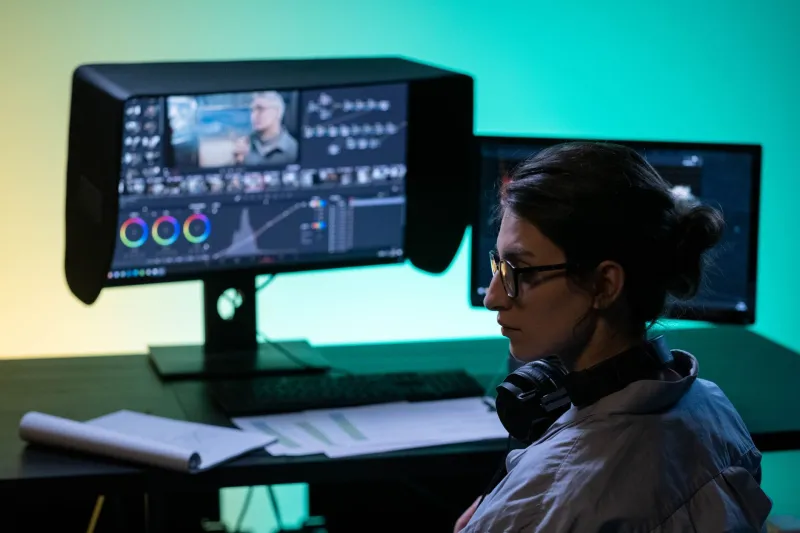
If concept art is where a shot is imagined and previs is where it is planned, compositing is where it is fulfilled. The compositor's role is frequently misunderstood — even within the industry — as a purely technical finishing step. In reality, skilled compositing is a form of visual storytelling in its own right.
A compositor integrates rendered CG elements with live-action photography, adjusting color, light, depth of field, grain, and atmospheric effects to create a seamless unified image. But beyond the technical integration, the best compositors are also reading the emotional intent of the original concept art and ensuring that the finished frame delivers on its promise.
Consider a sequence in which a digital creature emerges from shadow into firelight. The concept art established a specific quality of warmth — the way the light catches the texture of the creature's skin, the gradient from deep shadow to amber highlight. The modeling team built the geometry. The texture artists painted the surface. The lighting team placed virtual lights. But it is the compositor who makes the final judgment call about whether the finished image actually feels the way the original sketch intended.
That judgment is both technical and artistic, and it is the last line of defense between a director's imagination and the audience's experience.
The Human Element in a Technical Process
What ultimately distinguishes exceptional VFX work from merely competent work is the degree to which human creative judgment is preserved and honored throughout the pipeline. Technology has made it possible to build virtually anything on screen. The harder discipline is ensuring that what gets built remains faithful to why it was conceived in the first place.
At BranitVFX, the philosophy has always been that the technical pipeline exists to serve the creative vision — not the other way around. Every tool, every workflow, every review process is designed to reduce the friction between a director's imagination and the final frame. The goal is not simply to execute a shot. It is to deliver the feeling that was embedded in the original sketch, carried faithfully through every stage of production, and finally, precisely, placed on screen.
That is the invisible architecture behind every visual effects shot that moves an audience without them ever knowing quite why.