Current Demands: How Modern VFX Studios Are Rewiring the Infrastructure of Imagination
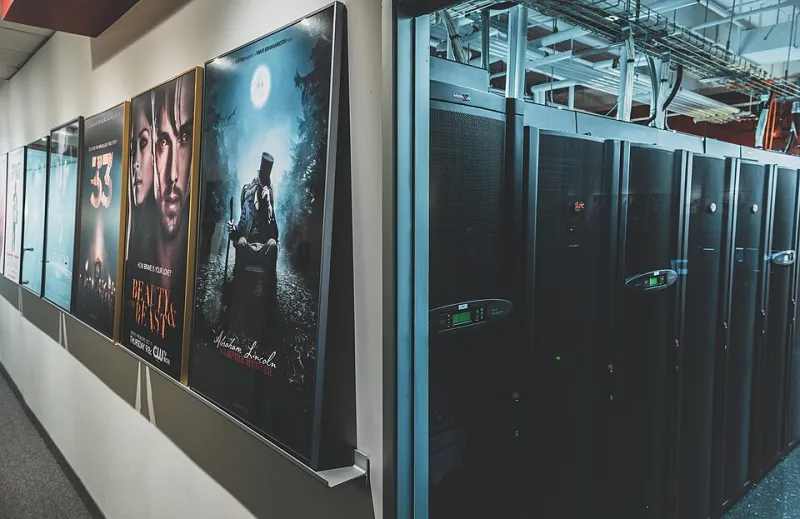
Photo: KSingh1991, CC BY-SA 4.0, via Wikimedia Commons
There is a scene playing out in data centers across California, Vancouver, and London that has nothing to do with the films being made inside them. Rows of servers glow in climate-controlled rooms, consuming electricity at rates that would humble a mid-sized American manufacturing plant. These are the render farms — the industrial backbone of modern visual effects — and they are quietly approaching the outer edges of what existing power infrastructure can support.
The crisis is not hypothetical. It is operational, financial, and increasingly environmental. As productions demand ever-larger volumes of photorealistic imagery delivered on shorter schedules, the computational requirements of VFX pipelines have expanded at a pace that outstrips the capacity of the grids that studios depend upon. For many facilities, the question is no longer whether their infrastructure can handle the load. The question is what happens when it cannot.
The Arithmetic of Ambition
To understand the scale of the problem, consider what rendering a single feature film actually requires. A modern blockbuster with substantial VFX work — the kind of production that fills multiplexes from coast to coast — may involve hundreds of millions of individual render hours distributed across thousands of processing nodes. Each of those nodes consumes electricity continuously, generates heat that must be mechanically removed, and contributes to a facility-wide power draw that can reach into the megawatts during peak production periods.
Industry analysts who track infrastructure spending at major VFX facilities describe a consistent pattern: as visual ambition scales upward, energy costs follow with compounding intensity. A supervisor at a mid-sized American VFX studio, speaking on background, described receiving a utility bill during a particularly dense production period that exceeded the combined salary cost of his compositing department for the same month. That figure, he noted, was not anomalous. It was becoming routine.
The arithmetic grows more complicated when studios contend with simultaneous productions — a reality for any facility working at competitive scale. Running multiple large projects concurrently does not simply double the load. It multiplies coordination complexity, strains cooling systems, and creates periods of peak demand that utilities in some regions struggle to accommodate without imposing surcharge penalties.
Building Off the Grid
The response from a forward-thinking segment of the industry has been decisive, if quietly executed. Rather than accepting dependence on municipal power infrastructure, several studios have begun investing in on-site generation capabilities that reduce or eliminate their reliance on the external grid during high-demand periods.
Solar installations have become a practical option for facilities in the American Southwest and along the Pacific Coast, where consistent sunlight and favorable state incentive programs make the capital investment recoverable within a reasonable timeframe. Some studios have paired solar arrays with industrial-scale battery storage systems, allowing them to bank energy during off-peak hours and deploy it during the render surges that accompany final delivery deadlines.
Other facilities have pursued relationships with renewable energy providers through power purchase agreements — contractual arrangements that guarantee a supply of wind or hydroelectric power at fixed rates, insulating the studio from the price volatility that makes budgeting for render-intensive productions so unpredictable. In the Pacific Northwest, where hydroelectric capacity is abundant, several VFX operations have relocated satellite render infrastructure specifically to take advantage of lower-cost, lower-carbon electricity.
Natural gas-powered microgrid installations represent a less environmentally progressive but operationally pragmatic option that some studios have adopted as a transitional measure. These systems provide reliable backup generation during grid stress events — a growing concern as climate-related disruptions increasingly threaten power stability in key production markets.
The Environmental Ledger
The sustainability dimensions of render farm energy consumption have begun attracting scrutiny from investors, insurers, and a generation of VFX artists who are increasingly vocal about the environmental implications of their work. The carbon footprint of a single high-profile streaming series, when render energy is factored into the production's total emissions accounting, can be substantial — a fact that sits uncomfortably alongside the entertainment industry's public commitments to decarbonization.
Some studios have responded with genuine transparency, publishing emissions data and establishing credible reduction targets. Others have adopted the language of sustainability without making the structural investments required to support it. The distinction matters, and professionals within the industry are beginning to develop the institutional knowledge to tell the difference.
The most rigorous approaches involve full lifecycle accounting — not merely the energy consumed during rendering, but the manufacturing footprint of the hardware itself, the emissions associated with data transmission, and the eventual disposal of equipment that becomes obsolete on cycles that grow shorter with every hardware generation. Studios that engage with this level of analysis tend to make meaningfully different infrastructure decisions than those that focus exclusively on operating costs.
What the Industry Owes Itself
The render farm energy crisis is, at its core, a planning failure that accumulated gradually over decades of prioritizing capability over consequence. The industry built its appetite for computational spectacle without building the infrastructure philosophy to sustain it responsibly.
That reckoning is now unavoidable. Studios that invest in energy independence and renewable sourcing are discovering a competitive advantage that extends beyond ethics — stable, predictable energy costs improve financial planning, reduce production risk, and insulate facilities from the utility rate increases that are projected to accelerate across major American markets over the coming decade.
The facilities that resist this transition face a compounding disadvantage. As talent increasingly factors sustainability into employment decisions, and as major studio clients begin incorporating environmental criteria into their vendor selection processes, the cost of inaction is rising alongside the kilowatt-hour.
The render farm was always a symbol of ambition — the place where imagination is converted into image at industrial scale. The studios now building their own power infrastructure are simply extending that ambition to include the world outside the frame. That extension, long overdue, may prove to be one of the most consequential creative decisions the VFX industry makes in this decade.