The Final Gatekeeper: How Compositors Silently Determine Whether a Blockbuster Looks Brilliant or Broken
Every summer, American audiences pack multiplexes to witness spectacles that defy physical reality — superheroes breaching the stratosphere, ancient cities crumbling into dust, creatures that evolution never produced lumbering across alien landscapes. The conversation afterward almost always circles back to the same names: the director, perhaps the VFX supervisor, occasionally the production designer. Almost no one mentions the compositor.
That omission is not accidental. It is, in a peculiar way, the highest possible compliment the craft can receive. When compositing succeeds completely, it becomes invisible. And invisibility, in this industry, is the entire point.
What a Compositor Actually Does
To understand why compositing matters so profoundly, it helps to understand what the discipline actually encompasses. A finished visual effects shot is not a single image — it is an archaeological stack of discrete elements. There may be a live-action plate filmed on a soundstage in Atlanta or Burbank, a separately rendered CG character, a digital background environment, atmospheric haze passes, lens flares, shadow mattes, depth-of-field layers, color correction nodes, and dozens of additional components that each originated in a different department, on a different machine, sometimes in a different country.
The compositor's task is to combine all of these elements into a single frame that reads, to an audience watching at 24 frames per second, as a unified, photographically coherent moment in time. That task repeats for every frame in the shot — and a single effects sequence in a contemporary blockbuster may contain thousands of frames.
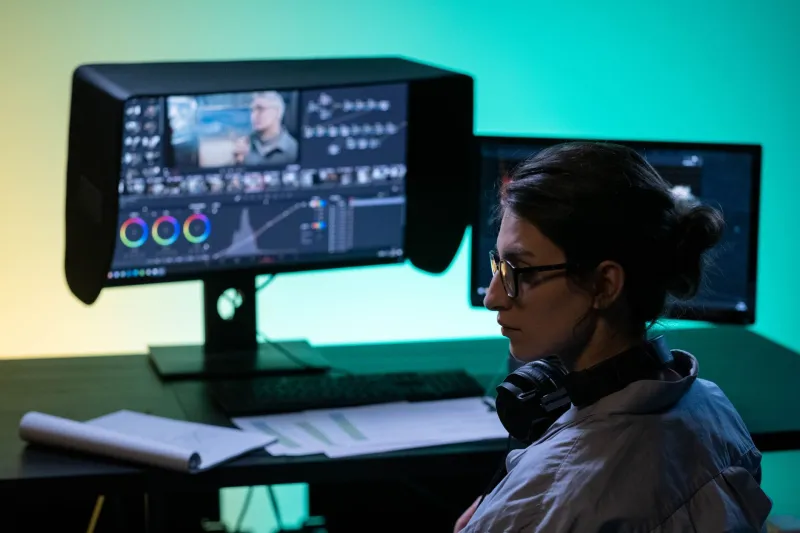
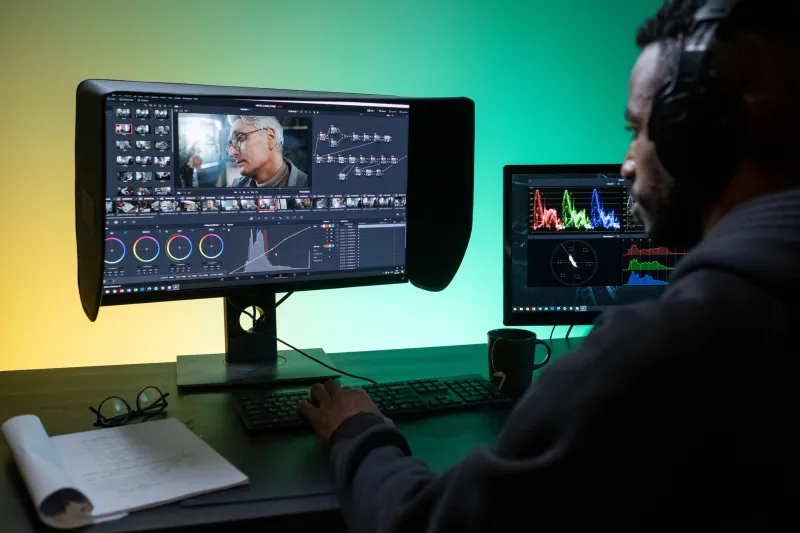
The tools most commonly associated with this work — software platforms like Foundry's Nuke, which has become the dominant compositing application across major US facilities — are extraordinarily sophisticated. But the software is only as capable as the human interpreting its output. Every decision about how light falls across a digital surface, how motion blur integrates with a live-action background, or how the color temperature of a rendered element harmonizes with the photographic plate underneath requires judgment that no algorithm can fully automate.
The Uncanny Valley Lives in the Details
The concept of the uncanny valley — that unsettling region where something looks almost, but not quite, human or real — is frequently invoked in discussions of digital characters. What is less commonly understood is that compositing failures are often the actual mechanism by which a shot tumbles into that valley.
A CG element rendered with extraordinary technical precision can be destroyed at the compositing stage by a single misjudged decision. An edge that is too sharp against a soft background. A shadow that falls at a fractionally incorrect angle. A specular highlight that doesn't quite match the color temperature of the practical lighting on set. Human perception is extraordinarily sensitive to these inconsistencies, even when viewers cannot articulate what they are reacting to. They simply feel that something is wrong.
Conversely, a compositor working with imperfect raw materials — a rushed render, a poorly lit plate, a mismatch between on-set conditions and the digital environment — can salvage a shot through technical ingenuity and a deep understanding of photographic reality. Some of the most celebrated effects sequences in recent American cinema were built on foundations that would have alarmed anyone who saw the raw elements. The compositor was the person who made them work.
The Pace and Pressure of the Final Stage
Compositing occupies the final stage of the visual effects pipeline, which means it absorbs the accumulated consequences of every upstream decision. When a shoot runs long, when a render farm falls behind schedule, when a director requests a late change to a character design — the timeline compression lands on the compositing department. Professionals working in this discipline at studios across Los Angeles, New York, and the broader US production landscape consistently describe a working environment defined by relentless deadlines and the expectation of flawless output under conditions that are anything but.
A senior compositor on a major studio tentpole may be responsible for hundreds of shots across a single production, each requiring individual attention and each subject to revision requests from supervisors, directors, and studio executives who may not fully understand the technical constraints involved. The ability to maintain creative precision under that kind of institutional pressure is itself a specialized skill, one that is rarely acknowledged in the credits that roll past audiences already heading for the exits.
Artistic Judgment Disguised as Technical Work
One of the persistent mischaracterizations of compositing is the assumption that it is primarily a technical discipline — a matter of following established procedures and executing defined tasks. Practitioners consistently push back against this framing, and the pushback is well-founded.
Deciding how a digital sky integrates with a live-action horizon is not a mathematical problem with a single correct answer. It is an aesthetic judgment informed by an understanding of photography, cinematography, atmospheric optics, and the specific visual language a particular film is attempting to establish. A compositor working on a gritty, desaturated thriller makes fundamentally different decisions than one working on a brightly lit, heightened comic book adaptation — even when the underlying technical challenges are similar.
The best compositors in the industry are, in effect, visual artists who happen to work in a medium defined by computation. Their understanding of how light behaves, how film grain reads, how human vision processes edge contrast and color relationships, is as sophisticated as anything possessed by a cinematographer or a production designer. The difference is that cinematographers and production designers receive credit, awards recognition, and cultural visibility. Compositors receive the quiet satisfaction of a shot that no one noticed.
The Case for Recognition
The Academy of Motion Picture Arts and Sciences awards a Visual Effects Oscar each year, and the recipients are typically VFX supervisors representing the studios that produced the nominated work. Individual compositors are rarely named in acceptance speeches. The broader awards ecosystem in the US entertainment industry has no dedicated category for compositing, despite the discipline's centrality to the finished product.
This is not merely a question of fairness, though fairness is certainly relevant. It is also a question of institutional knowledge and cultural understanding. When audiences, journalists, and even industry professionals lack a clear picture of what compositors actually do and how their decisions shape the films they watch, the field loses its ability to attract, retain, and properly compensate the talent it depends on.
The visual effects industry in the United States has faced well-documented challenges around labor conditions, outsourcing pressures, and the difficulty of sustaining skilled workforces over time. Greater public understanding of what compositors contribute — and what is lost when that expertise is undervalued — is not a peripheral concern. It is directly connected to the long-term health of the craft itself.
The Invisible Art That Makes Everything Else Possible
There is something quietly remarkable about a discipline whose greatest achievements are defined by what audiences fail to perceive. The compositor's masterwork is the shot that generates no reaction at all — not because it is unimpressive, but because it is so thoroughly convincing that the audience's attention remains entirely on the story, the character, the emotion the filmmakers intended to convey.
That is an extraordinarily difficult thing to accomplish. It requires technical mastery, artistic sensibility, physical stamina, and a specific kind of professional humility that is willing to subordinate individual recognition to the integrity of the whole. The frame that holds everything together is, in the end, the frame that no one ever questions.
The compositors who build those frames deserve to be known by name.