Garage-Level Genius: How Indie Filmmakers Are Closing the Gap Between Basement Budgets and Blockbuster Visuals
For most of cinema's history, the phrase "visual effects" carried an almost institutional weight. It implied vast server farms, teams of hundreds, and budgets that could fund a small municipality. The craft was sequestered behind studio walls, accessible only to those with the right contracts and the right zip codes. That era is ending — not with a dramatic announcement, but with a quiet, persistent revolution happening in spare bedrooms, college dorm rooms, and converted garages across the United States.
Today, a filmmaker in Tulsa with a used mirrorless camera and a consumer-grade laptop can composite a photorealistic space battle, simulate fluid dynamics, or render a fully digital character — all without ever setting foot on a studio lot. The tools that once demanded enterprise licensing fees and specialized hardware have become affordable, in some cases entirely free. What this means for storytelling, for the VFX industry, and for the very definition of "professional" filmmaking is a conversation worth having in earnest.
The Software Reshaping the Landscape
Three platforms have become something close to sacred texts within the independent filmmaking community.
Blender, the open-source 3D creation suite maintained by the Blender Foundation, has undergone a transformation so dramatic that even veteran studio artists have taken notice. Its Cycles and EEVEE rendering engines now produce imagery of genuine cinematic quality, and its node-based compositing system offers capabilities that rival software costing thousands of dollars annually. Critically, it costs nothing. For an independent creator operating on a shoestring, that distinction is not trivial — it is everything.
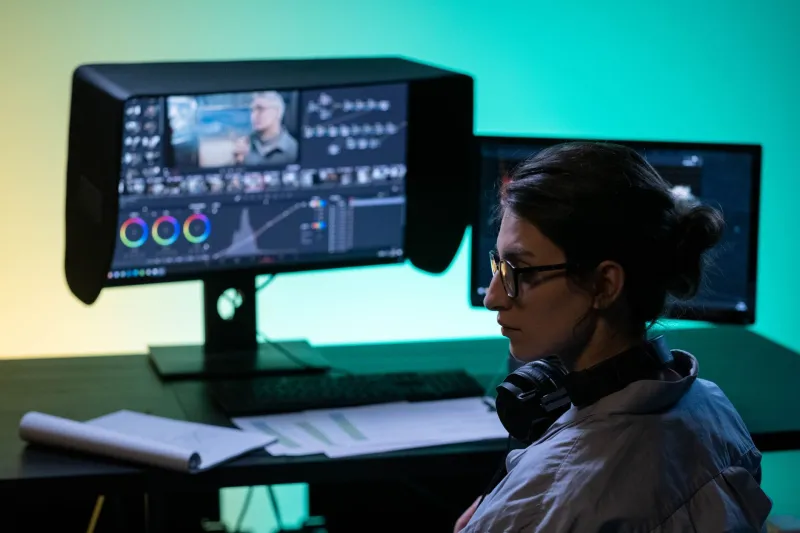
DaVinci Resolve, developed by Blackmagic Design, began its life as a color grading application favored by Hollywood colorists. Its evolution into a full post-production suite — incorporating editing, color, audio, and the Fusion compositing environment — has made it an extraordinarily powerful all-in-one platform. The free version retains a remarkable breadth of functionality, and the paid Studio license remains accessible at a one-time cost that pales against subscription-based competitors.
Adobe After Effects occupies a slightly different space. As the industry standard for motion graphics and compositing, it carries a monthly subscription cost, but its ubiquity means that tutorials, assets, and community support are virtually inexhaustible. For filmmakers already embedded in the Adobe ecosystem, it remains an indispensable instrument.
Together, these three tools form the backbone of a new independent VFX pipeline — one that is leaner, more agile, and increasingly capable of producing images that challenge the supremacy of traditional studio output.
Profiles in Independent Innovation
Corridor Crew — the YouTube channel and production outfit based in Los Angeles — occupies a fascinating position in this conversation. While the team has grown beyond a true "indie" operation, its origins and ongoing ethos reflect precisely the spirit of accessible filmmaking under discussion. Wren Weichman and Niko Pueringer built their reputation on demonstrating that compelling action sequences and convincing digital effects could be achieved with modest resources and extraordinary ingenuity. Their short films, produced independently before their channel's massive growth, used After Effects and practical in-camera techniques to create work that regularly prompted viewers to question their production budgets. Their ongoing influence on a younger generation of creators is immeasurable.
 Photo: Corridor Crew, via www.panoramaaudiovisual.com
Frederick Jones, a filmmaker based in Atlanta, Georgia, has garnered significant attention within independent genre circles for his science fiction short films. Working predominantly within Blender and DaVinci Resolve, Jones has produced sequences featuring fully rendered spacecraft, digital environments, and particle simulations — work that, viewed without context, might reasonably be attributed to a small professional studio. In interviews, he has cited Blender's rapidly expanding community documentation and the generosity of the open-source asset ecosystem as the primary reasons his work has been able to scale visually without a corresponding increase in cost.
 Photo: Frederick Jones, via alvarotrigo.com
Jourdan Aldredge, a filmmaker and writer operating out of Nashville, Tennessee, has written extensively about his own production workflow, offering an unusually transparent window into what independent VFX creation actually looks like in practice. His work with After Effects and DaVinci Resolve on short-form content demonstrates how a disciplined, iterative approach to compositing — layering practical photography with digital elements — can produce results that feel genuinely cinematic, even when the production footprint is minimal.
 Photo: Jourdan Aldredge, via buonim.it
What This Shift Means for the Industry
The implications of this democratization are not uniformly comfortable for the established VFX industry. On one hand, the expansion of the talent pool is undeniably healthy. Studios and productions that once had to recruit from a narrow pipeline of formally trained artists now have access to a far broader ecosystem of self-taught creators who have demonstrated real-world capability. Independent filmmakers who have mastered Blender or Fusion on their own initiative often arrive with problem-solving skills and creative flexibility that structured training programs do not always cultivate.
On the other hand, the compression of costs raises legitimate concerns about the devaluation of professional VFX labor. When a single individual can produce work of near-professional quality, the pressure on studios to justify the expense of larger teams intensifies. This is a tension the industry will need to navigate with care, ensuring that the democratization of tools does not become a rationale for the erosion of fair compensation and sustainable working conditions for professional artists.
For storytelling itself, the consequences are almost entirely positive. Genres and narrative ambitions that were previously foreclosed to independent creators — science fiction, fantasy, horror with creature effects — are now genuinely viable. Stories that could not attract studio investment because of their perceived visual complexity can now be realized by determined individuals with access to the right software and the patience to learn it.
The Frame Has Widened
At BranitVFX, we have always believed that the most powerful force in visual effects is not computational power or budget — it is imagination meeting craft. What the current generation of accessible tools has accomplished is the removal of the financial barrier that once stood between that imagination and its realization on screen.
The filmmakers working in their garages and spare rooms today are not merely hobbyists. Many of them are the studio artists, directors, and VFX supervisors of the next decade. The tools have changed. The ambition, it turns out, was always there.