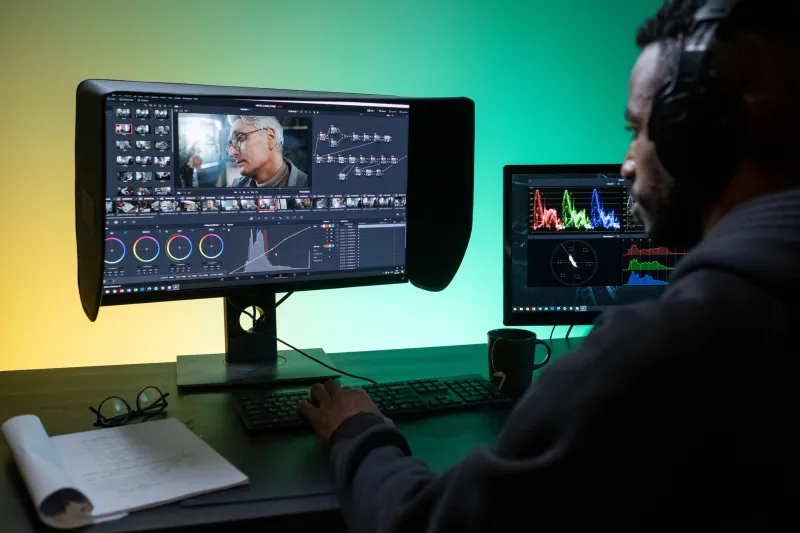
When Chaos Follows Rules: The Simulation Artists Who Teach Physics to Explode on Command

There is a particular kind of satisfaction that comes from watching something magnificent fall apart. A skyscraper buckles at its base and folds into a cloud of concrete dust. A rogue wave swallows a ship whole. A pane of glass catches a bullet and fractures into a thousand precise, glittering shards. These moments feel viscerally, unmistakably real — and yet every fragment of that destruction was planned, calculated, and revised dozens of times before a single frame was rendered.
The people responsible for that illusion carry a job title that rarely appears in awards speeches or magazine profiles: simulation artist. Their discipline sits at a demanding intersection of applied physics, software engineering, and visual storytelling, and it may be the least publicly understood specialty within the entire visual effects pipeline.
The Physics Engine as a Creative Instrument
At the core of a simulation artist's toolkit is the physics engine — a software system that models how matter behaves under force. Platforms such as Houdini, Bifrost within Autodesk Maya, and proprietary in-house solvers allow artists to define properties for virtually any material: the tensile strength of steel, the viscosity of water, the brittleness of ceramic tile. Once those parameters are established, the engine runs a simulation that approximates how that material would behave in the real world under the conditions the artist specifies.
The word "approximates" is doing considerable work in that sentence. True physical simulation at the scale required for feature film production is computationally prohibitive. A simulation that perfectly modeled every molecule in a collapsing building would take years to calculate on current hardware. What simulation artists actually do is find the most convincing mathematical shortcut — a version of reality accurate enough to satisfy the human perceptual system without bankrupting the production's render farm.
That negotiation is where the artistry begins.
The Instinctive Audience
One of the most fascinating aspects of simulation work is the way audiences respond to its failures without being able to articulate what has gone wrong. Research in perceptual psychology suggests that human beings develop deeply calibrated expectations about how physical systems behave from the first moments of childhood. We learn gravity, friction, and momentum not through equations but through embodied experience — dropping things, catching things, watching things break.
When a simulation violates those expectations, even subtly, viewers register something uncomfortable. Debris that moves too uniformly. Water that lacks the chaotic micro-turbulence of real surf. Cloth that drapes with a stiffness that no natural fiber would produce. The audience may never identify the specific error, but they will describe the sequence as "fake" or "off" or, most damagingly, "video game-like" — a phrase that has become shorthand in Hollywood for a simulation that failed to cross the threshold of believability.
This means simulation artists are perpetually calibrating their work against a test audience that cannot tell them precisely what it needs, only whether it has received it.
Destruction as Choreography
The most visible application of simulation in American cinema is large-scale destruction — the kind of catastrophic structural failure that has become a defining visual grammar of the blockbuster era. Films produced by major studios regularly feature sequences in which entire city blocks are demolished, bridges collapse into rivers, or aircraft disintegrate at altitude. Each of these sequences requires a simulation artist to make a series of deeply consequential creative decisions before a single calculation is run.
How should the destruction begin? At what rate should it propagate? Where should the eye be directed as the chaos unfolds? These are not purely technical questions. They are questions of dramatic pacing, of visual rhythm, of emotional architecture. A building that collapses too quickly denies the audience the opportunity to process the scale of what they are witnessing. One that collapses too slowly loses the sense of inevitability that gives destruction its emotional weight.
The simulation artist works closely with the VFX supervisor and, often, the director to establish what might be called a destruction tempo — a cadence of failure that serves the narrative rather than merely the physics. This frequently means running dozens of simulations with subtly adjusted parameters until the collapse feels both plausible and dramatically satisfying, two qualities that do not always naturally align.
Fire, Water, and the Tyranny of Fluids
If rigid body destruction — the simulation of solid objects breaking apart — represents one pole of the discipline, fluid simulation represents the other, and it is considerably more computationally punishing. Water, fire, smoke, and similar phenomena are governed by equations, most notably the Navier-Stokes equations for fluid dynamics, that describe behavior across an enormous range of scales simultaneously. The foam on a cresting wave and the deep-water swell that produces it are governed by the same underlying physics, but capturing both in a single simulation demands resources that no production budget can fully accommodate.
Simulation artists working on fluid sequences spend considerable time developing what the industry calls multi-resolution approaches — techniques for simulating large-scale fluid behavior at lower resolution while concentrating computational resources on the high-detail areas the camera will actually see. The result is a kind of perceptual triage, directing the audience's attention toward the elements most likely to trigger their physical intuitions while economizing on the elements that will remain peripheral.
Fire presents its own distinct challenges. Unlike water, which audiences encounter in everyday life in forms that closely resemble its cinematic depictions, the fire in Hollywood productions is almost always larger, more sustained, and more dramatically structured than anything most viewers have witnessed firsthand. This gives simulation artists somewhat more latitude in their interpretations — but it also means that fire simulations that feel unconvincing tend to read as unconvincing in a particularly conspicuous way, because the audience has no precise real-world reference to explain away the discomfort.
The Collaboration No One Sees
Simulation artists rarely work in isolation. Their outputs feed directly into the work of effects compositors, lighting technical directors, and render wranglers — the broader ecosystem of specialists who assemble a finished visual effects shot. A simulation that produces beautiful, physically plausible motion can still fail if its outputs are not structured in a way that allows downstream artists to light and composite it effectively.
This requires simulation artists to think not only about what their work looks like in isolation but about how it will behave when it is integrated into a live-action plate with real lighting conditions, real camera movement, and real environmental context. It is a discipline that demands both deep technical specialization and a broad understanding of the entire VFX pipeline — a combination that takes years to develop and that the industry's most experienced practitioners spend entire careers refining.
The Quiet Precision Behind the Spectacle
The simulation artist's contribution to American cinema is, by design, invisible. When their work succeeds, audiences experience only the visceral, unquestioned reality of a world coming apart at the seams. The mathematics disappears. The software disappears. The dozens of rejected simulations disappear. What remains is the sensation — that particular, irreplaceable feeling of watching something enormous and inevitable unfold.
It is, in its own way, a form of craftsmanship as demanding and as disciplined as any other in the entertainment industry. And it is one that the most discerning observers of visual effects — the ones who understand what it takes to make chaos this convincing — have every reason to recognize.