Steel, Stone, and Pixels: The Art and Science of Building Fictional Cities That Fool the Human Eye

There is a particular kind of trust that forms between an audience and a film. It is fragile, almost subconscious, and it can collapse in an instant — a reflection that doesn't belong, a shadow that falls in the wrong direction, a building facade that looks slightly too clean. For the VFX artists tasked with constructing entirely digital cities, that trust is both the goal and the constant threat. Their job is not simply to build something impressive. It is to build something believable.
Across the American entertainment landscape, fully rendered digital environments have become one of the most ambitious and quietly transformative disciplines in visual effects production. The neon-soaked corridors of cyberpunk futures, the sun-bleached plazas of ancient civilizations, the fog-wrapped skylines of alternate histories — these are no longer supplemented by location shooting or physical sets. In many productions, they exist entirely within the machine, assembled by teams of artists, technical directors, and researchers working in concert over months or even years.
Understanding how they do it — and why it works — requires looking at the entire process from the first reference photograph to the final composite frame.
The Research Phase: Building a City Before You Build a City
Every convincing digital metropolis begins not with software, but with scholarship. Before a single piece of geometry is modeled, the world-building team conducts what might best be described as an architectural and cultural excavation.
For productions set in recognizable historical periods, this means consulting archaeologists, urban historians, and cultural institutions. What materials were available? How did social hierarchy manifest in building placement? What did the street-level experience actually feel like for an ordinary resident? These questions matter because the human eye, even in a darkened theater, is extraordinarily good at detecting anachronism.
For entirely fictional environments — the floating megacities of science fiction, the magically constructed capitals of fantasy — the research process inverts. Rather than uncovering what existed, the team must establish internal logic. What is the power source? How does commerce flow? Where do people sleep, worship, work? A city without answers to these questions will look like a backdrop. A city with them will look like a place.
This distinction is not cosmetic. It is structural. The decisions made during the research phase determine everything from the density of street-level detail to the way light reflects off surfaces across different districts.
Procedural Pipelines: Engineering Scale Without Losing Soul
One of the central technical challenges in digital city construction is scale. A believable metropolis cannot consist of a few dozen hero buildings surrounded by vague geometry. It must extend — convincingly — to the horizon and beyond. Achieving that without an impossibly large team requires procedural modeling pipelines.
Procedural generation allows artists to establish rules rather than individual assets. Define the architectural grammar of a neighborhood — the proportional relationships between windows and walls, the rhythm of setbacks and overhangs, the palette of surface materials — and the system can populate entire city blocks according to that grammar. The result is variation that feels organic rather than repetitive, because it follows the same logic a real city follows when it grows over time.
But procedural tools are only as intelligent as the artists who configure them. The risk of over-reliance on automation is a city that feels generated rather than inhabited. The most accomplished VFX teams treat procedural systems as a foundation, then layer hand-crafted detail on top — particularly at the street level, where audiences are most likely to scrutinize what they see.
Signage with deliberate inconsistency. Wear patterns on pavement that suggest decades of foot traffic. Electrical conduit running in slightly impractical directions, the way it always does in real buildings. These are not accidents. They are decisions, made by artists who understand that imperfection is the language of authenticity.
The Street Level: Where Belief Lives or Dies
Aerial establishing shots can be spectacular. They can communicate scale, geography, and mood in a single frame. But audiences do not form emotional relationships with cities from above. They form them at street level, in the spaces where characters move, speak, and make choices.
This is where digital city construction becomes most demanding — and most revelatory. At street level, the camera can linger. Surfaces must hold up to scrutiny. The interaction between light and material must behave consistently across every frame. A cobblestone that looks correct at noon must look equally correct at dusk, in rain, under artificial illumination.
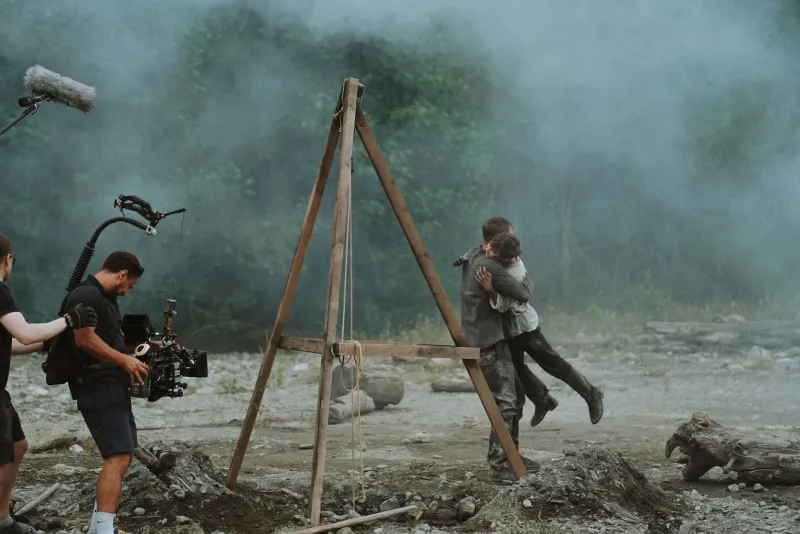
Lighting simulation has become one of the most critical disciplines in this work. Global illumination systems now allow light to bounce, scatter, and absorb in ways that closely approximate physical reality. The challenge is ensuring that the digital environment's lighting matches the lighting captured on set, where actors and practical elements must integrate seamlessly with the digital world surrounding them.
This integration — the marriage of photographed performance with rendered environment — is perhaps the most delicate operation in the entire pipeline. Even a slight mismatch in color temperature, shadow direction, or ambient occlusion can break the illusion. The best compositors describe this work less as technical execution and more as a form of perceptual psychology.
Director Vision and the Architecture of Story
A digital city is never built in isolation from the story it serves. The most architecturally sophisticated environment in the world is a failure if it does not support the emotional and narrative intentions of the director.
This means that world-builders must be storytellers as much as they are technicians. A city designed to communicate oppression will make different choices than one designed to evoke wonder. The angle of streets, the relationship between public and private space, the presence or absence of greenery — all of these carry meaning, and all of them must align with what the director is trying to say.
The most productive collaborations between directors and VFX teams are those in which these conversations happen early and remain ongoing. When a director can articulate not just what a city looks like but what it feels like to live there, the world-building team has the foundation they need to make decisions at every level of the pipeline — decisions that compound into an environment audiences inhabit rather than merely observe.
The Horizon of the Discipline
The capabilities available to digital city builders today would have been unrecognizable a decade ago. Real-time rendering engines originally developed for the gaming industry have migrated into film and television production, allowing artists to visualize complex environments with unprecedented immediacy. Machine learning tools are beginning to assist in texture generation and detail population, reducing the time required for certain categories of work without diminishing artistic control.
Yet the fundamental challenge remains unchanged. Technology is not what makes a fictional city convincing. What makes it convincing is the accumulated weight of considered decisions — the research that precedes the modeling, the imperfections that are chosen rather than tolerated, the street-level details that no audience member will consciously notice but every audience member will unconsciously absorb.
The invisible cities that populate American film and television are invisible precisely because they have been built with such care. The moment the craft becomes visible, the city ceases to exist. That paradox is, in many ways, the defining condition of world-building at the highest level — and the reason the artists who practice it are among the most essential, and least celebrated, contributors to the stories we tell.